Why Automation Builders Are Listing on AutoStack Instead of Giving Templates Away for Free
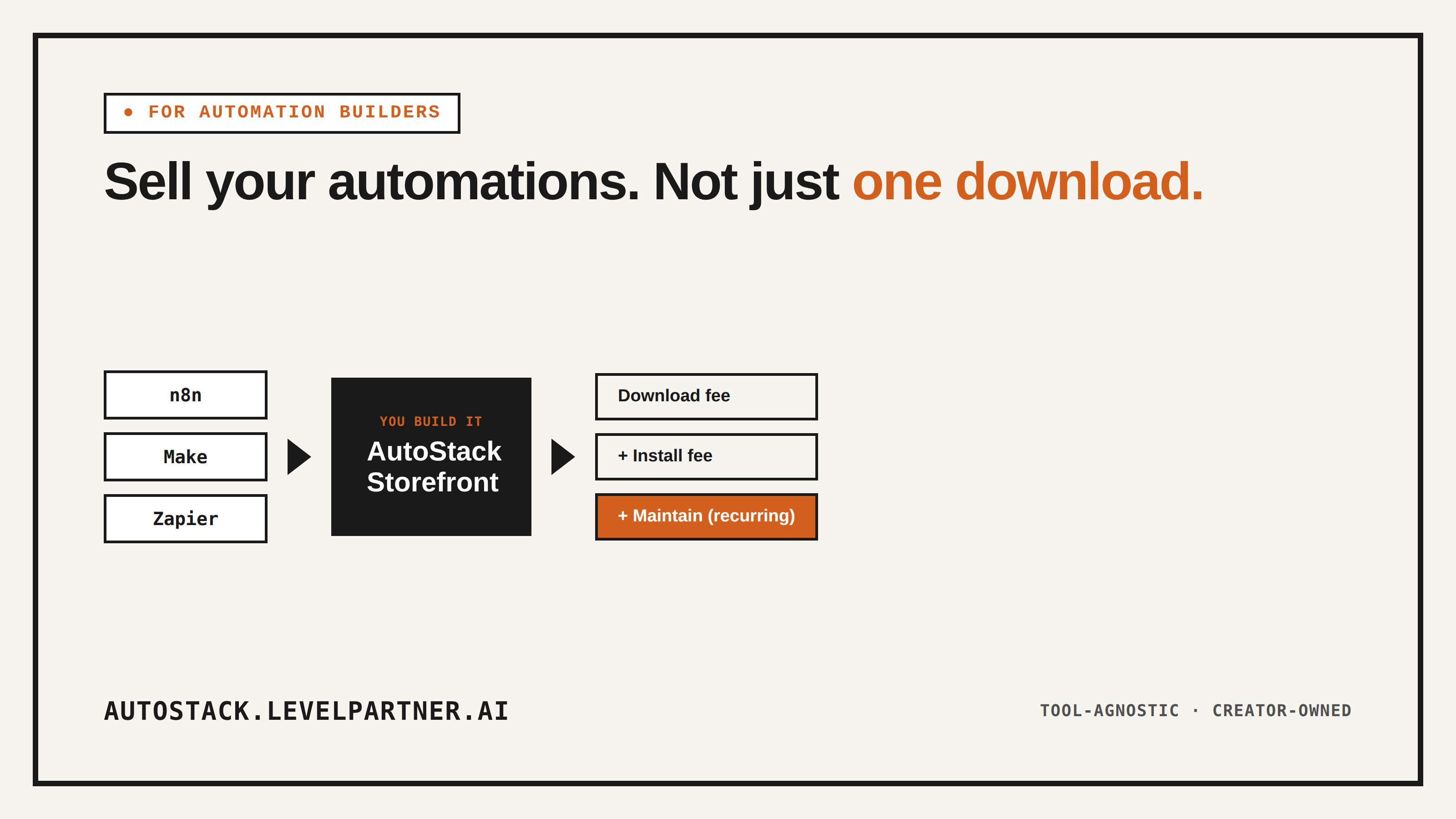
You already build great automations for clients. Here's how AutoStack turns that skill into a real, tool-agnostic storefront instead of one more freelance gig or a free template nobody supports.
You've already built the hard part
If you build automations — in n8n, in Make, in Zapier, in whatever tool fits the job — you've probably built the same handful of "amazing, this saved me hours" workflows more than once, for more than one client. A lead-routing system. A content repurposing pipeline. An invoice-chasing sequence. You solve the problem once, and then you solve a slightly different version of the same problem again for the next client, starting mostly from scratch because there was never really a place to package and reuse what you'd already built.
Meanwhile, the free-template route — posting a workflow in a Facebook group or a community forum in exchange for engagement — gets you visibility, but it rarely gets you paid, and it definitely doesn't get you paid again when that same template keeps saving someone time six months later. You did the work once and captured almost none of the ongoing value.
AutoStack was built for the gap between those two situations.
Tool-agnostic means your skill isn't boxed in
A lot of template marketplaces are built around a single platform — n8n templates on an n8n-specific site, Zapier templates in Zapier's own directory. That's fine until the tool you're best at isn't the tool that's trending, or until a client's stack forces you into a different platform than the one you have templates built for.
AutoStack doesn't box builders into one tool. Listings on the marketplace span n8n, Make, Zapier, and others — the tool is a detail on the listing, not the organizing principle of the whole platform. That matters for builders in a very practical way: your expertise in solving automation problems is the actual asset, not your lock-in to one vendor's ecosystem. If you're fluent in more than one tool, or the right tool changes client to client, AutoStack's structure doesn't force you to pick a lane.
A monetization model built past the first sale
Here's the part that's easy to miss if you're used to thinking about templates as a one-time sale: AutoStack's three-tier structure — download, install, maintain — isn't just a buyer-facing convenience. It's a builder-facing revenue model.
Download is your base product — the workflow file itself, priced for what it is.
Install is where you get paid to do what you'd do for a client anyway: set the automation up correctly in their specific environment. Except now it's productized. You're not quoting a custom project from scratch every time; you're offering a known service against a known workflow you've already built and tested.
Maintain is the tier most builders leave on the table entirely when they sell templates the old way — and it's the one with the most obvious long-term upside. Automations break when APIs change. Someone has to notice and fix that. Right now, that's usually the buyer, discovering it the hard way. On AutoStack, it can be you, on a recurring basis, for every buyer who opts in — which means the same automation you built once can generate ongoing revenue for as long as it keeps running.
Downloads-only marketplaces cap your upside at "however many people buy the file." AutoStack's model is built so your best work can keep paying you after the initial sale, the same way a SaaS subscription does — except you're not the one who has to build and run the software company around it.
You're not competing with the platform giants — you're the specialist they can't be
It's worth being honest about scale here: general creator-economy marketplaces have grown into genuinely massive businesses — the kind that raise funding rounds at billion-dollar-plus valuations and move hundreds of millions of dollars a year in transaction volume. That's not a comparison meant to suggest AutoStack is trying to out-scale platforms like that. It's the opposite point: those numbers exist because there's proven, large appetite for creator-built digital products sold directly to the people who need them, and AutoStack is applying that same appetite to a category — AI automation — that's underserved by anything built specifically for it.
At the same time, the broader automation-tool space itself is growing fast, and community template libraries for tools like n8n have ballooned into the thousands. That volume is exactly the problem AutoStack's positioning solves for builders: when there are thousands of free, unsupported templates floating around, "I built something that works and I stand behind it" becomes a genuinely differentiated offer, not a redundant one.
What AutoStack looks like for builders right now
AutoStack is deliberately not trying to look bigger than it is before the substance is there. The approach has been to build out real, working categories with genuinely solid templates rather than rush to list as many as possible — the marketplace has been adding categories as specialists in different domains come on board, so builders whose focus isn't limited to one narrow niche have room to expand what they list over time. It also means joining now means being part of the platform while it's actively shaping which categories and creator terms come next, rather than joining a finished, static system later.
If you've been treating your automation templates as a portfolio piece instead of a product — something you show clients rather than something you sell directly — AutoStack is built to be the place that changes that math: a tool-agnostic storefront, a pricing model that pays you past the first sale, and access to buyers who are specifically looking for what you already know how to build.