What Is AutoStack? The Tool-Agnostic Marketplace for Ready-Made AI Automations
AutoStack is a marketplace where you buy, install, and get ongoing help with real AI automations — no coding, no platform lock-in. Here's exactly how it works and who it's for.
The problem with automation right now
If you've tried to automate anything in your business over the last two years, you've probably run into the same wall everyone else has: there's no shortage of automation tools — n8n, Make, Zapier, Airtable Automations, custom Python scripts glued together with cron jobs — but there's a real shortage of automations that actually work out of the box.
You watch a YouTube video, download a JSON file, import it into your workflow tool of choice, and then spend the next three hours untangling broken API credentials, deprecated nodes, and half-finished logic that assumes you already know what you're doing. Multiply that by every workflow you need — lead capture, invoice reminders, content repurposing, customer support triage — and "automating your business" quietly turns into a part-time job in itself.
AutoStack exists to close that gap.
So what is AutoStack, exactly?
AutoStack is a marketplace for pre-built, outcome-focused AI automations. Instead of browsing tutorials and reverse-engineering someone else's half-documented workflow, you go to AutoStack, find an automation that does the specific thing you need done, and get a working version of it — built by someone who has already solved the problem, tested the edge cases, and is available to help if something breaks.
Three things make it different from "just another template site":
It's tool-agnostic. AutoStack isn't tied to one automation platform. Templates on the marketplace are built in n8n, Make, Zapier, and other tools, depending on what's the right fit for the job — and the listing tells you exactly what you need before you buy. You're not locked into learning one vendor's ecosystem to get value out of the marketplace.
It's outcome-focused, not tool-focused. You don't search AutoStack for "n8n workflows." You search for the outcome you want — "automatically follow up with leads who don't respond in 24 hours," "turn one blog post into five pieces of social content," "sync new Stripe customers into my CRM and send a welcome sequence." The tool is an implementation detail. The result is the product.
It's built around a real relationship with the builder, not a one-time download. Automations aren't static files that go stale the moment an API changes. AutoStack's model reflects that — more on this below.
How AutoStack actually works: download, install, maintain
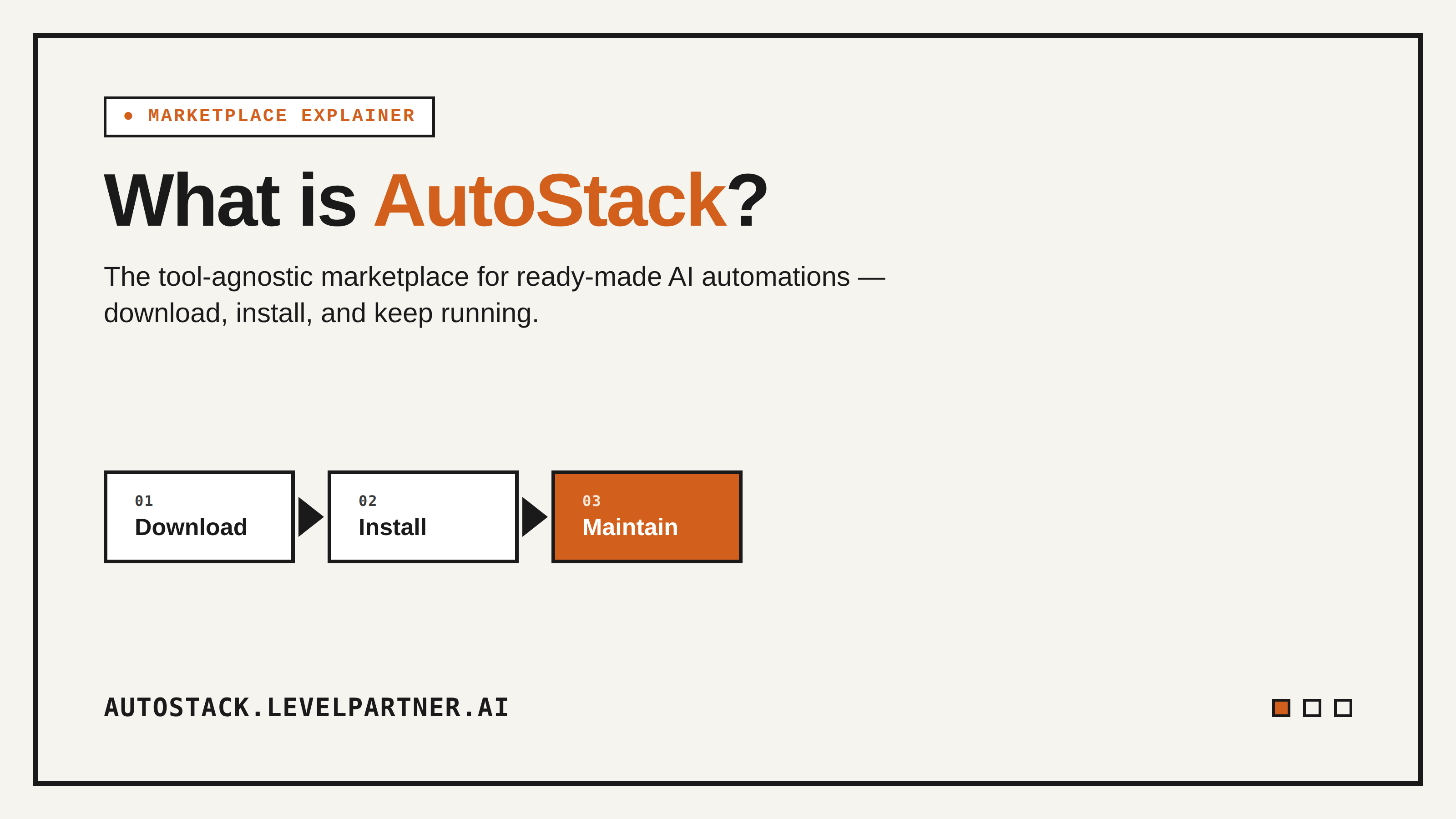
AutoStack is built around a simple three-tier model that mirrors how automations actually get used in the real world:
1. Download. Every listing shows you exactly what the automation does, which tool it runs on, what it connects to, and what it costs to get the base files. This is the "see it before you buy it" layer — enough detail that you know precisely what you're getting, with no fabricated reviews or inflated numbers standing between you and the decision.
2. Install. Getting a workflow file isn't the same as having a working automation. The install tier is where a creator sets it up in your actual environment — your accounts, your API keys, your specific edge cases — so it runs correctly from day one instead of becoming a weekend project.
3. Maintain. APIs change. Rate limits shift. A field gets renamed in some app you depend on and your "set and forget" automation quietly stops working three weeks later without telling you. The maintain tier means the person who built the automation keeps it running, instead of you finding out it broke when a customer complains that they never got their follow-up email.
You can stop at any tier that fits what you need. Some buyers just want the download and are comfortable wiring it up themselves. Others want the whole thing handled so they never have to think about it again. AutoStack is built to support both.
Who AutoStack is for
On one side, there are builders — people and small teams who don't have the time or inclination to become automation engineers, but who need specific, reliable workflows running in their business: agencies, e-commerce operators, service businesses, solo founders wearing every hat.
On the other side, there are automation specialists and creators — the people who already build these workflows for clients or for fun, and who currently have no great way to turn that skill into a repeatable, scalable business beyond one-off freelance gigs. AutoStack gives them a storefront, a monetization model that goes beyond a single download fee, and access to buyers who are actively looking for exactly what they've already built.
Why this matters now
AI-driven automation has gone from a niche technical skill to something every business is expected to have some version of. Tools like n8n have grown fast precisely because so much of modern work — lead follow-up, content repurposing, data syncing, reporting — is repetitive enough to hand off to a workflow, but specific enough that generic "AI assistant" tools don't quite solve it. At the same time, community template libraries have exploded into the thousands, which sounds great until you realize volume isn't the same as quality, and a free template with no support is often more expensive in wasted hours than a paid one that just works.
Marketplaces built around digital products and creator monetization more broadly have shown there's real appetite for this model — creator-driven marketplaces have scaled into the billions in transaction volume precisely because people will pay for something a specialist already built and stands behind, rather than assembling it themselves from scratch. AutoStack is applying that same logic specifically to AI automation: real builders, real outcomes, real accountability after the download button gets clicked.
Where AutoStack is today
AutoStack is still early and building deliberately rather than rushing to look bigger than it is. The team's approach has been to prove out real templates across a growing set of categories before scaling marketing — the philosophy is that ten genuinely solid automations beat a hundred half-finished ones for building trust with both buyers and the creators considering joining the platform. New categories are actively being added as automation specialists across different domains come on board, so the range of outcomes you can find on AutoStack keeps expanding.
If you've been putting off automating something in your business because the DIY route looked like more trouble than it was worth, that's exactly the gap AutoStack was built to close — browse for the outcome you want, see exactly what you're getting, and get it running with someone accountable for it actually working.