Build vs. Buy: The Real Cost of Building Workflow Automation In-House
The freelancer's quote isn't the real number. Here's every cost that actually shows up over a workflow's first year.
The number everyone compares is the wrong number
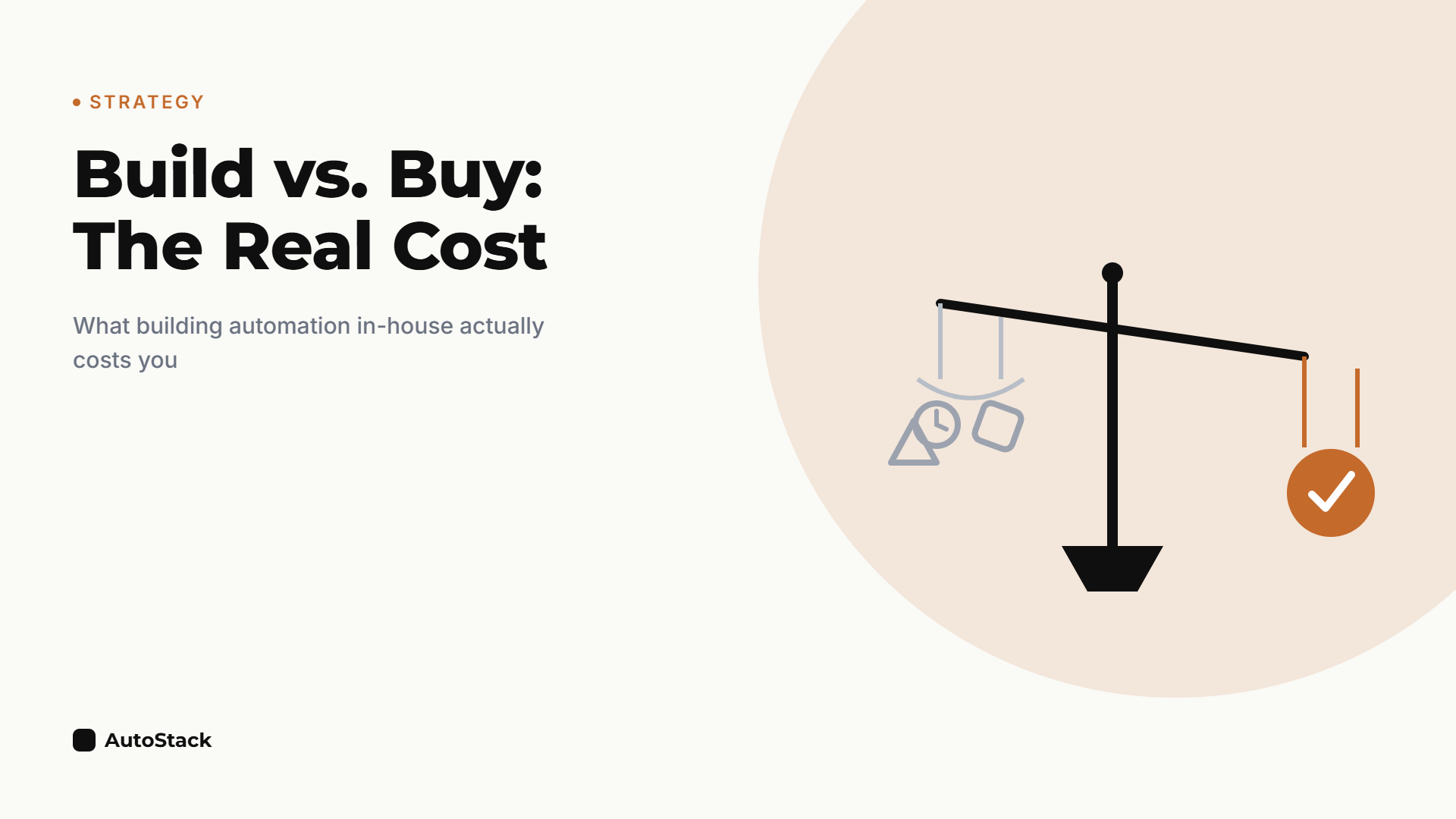
When a business decides between building an automation from scratch and buying a ready-made template, the comparison usually stops at "freelancer quote vs. template price." That's the smallest part of the real cost. The full comparison has to include discovery, debugging, and maintenance — three costs that a template purchase mostly skips and a from-scratch build doesn't.
Cost 1: discovery and spec time
Before anyone writes a single node or step, someone has to figure out exactly what the workflow needs to do, which edge cases matter, and which tools it needs to touch. For anything beyond a trivial two-step automation, this is real hours — usually underestimated, because "just connect the CRM to the email tool" always turns out to have five unstated exceptions once someone starts building it.
Cost 2: the build itself
This is the cost people actually price out — a freelancer's or agency's quoted hours. It's real, but on its own it undercounts what's coming next.
Cost 3: debugging edge cases you didn't think of
The first version of any custom automation reliably breaks on cases nobody anticipated: a contact with no email address, a webhook that fires twice, a date format from one region that a script doesn't expect. A workflow that's already been sold to dozens of buyers has had those edge cases found and patched already — you're not paying for the idea, you're paying to skip the discovery of every failure mode someone else already hit and fixed.
Cost 4: ongoing maintenance
APIs change. A field gets renamed in a CRM update. A rate limit gets tightened. Someone has to notice when an automation silently stops working and fix it — and "silently" is the operative word, since a broken automation usually doesn't announce itself, it just quietly stops doing its job until someone notices a week later that no leads have been routed. A maintained template purchase (with an ongoing support tier) puts that burden on the creator instead of on your own team's attention.
Where the math actually favors building it yourself
If the workflow is genuinely unique to your business — deeply specific to an internal system nobody else uses — there's no template to buy in the first place, and building is the only option. Building also makes sense if you already have in-house automation talent sitting partly idle; in that case the marginal cost of one more workflow is lower than it would be for a company hiring a freelancer from zero.
Where buying wins, almost every time
For anything common enough that other businesses in similar situations have needed the same thing — lead routing, invoice follow-ups, content repurposing, review requests — someone has almost certainly already built, tested, and sold a version of it. At that point, paying a few hundred dollars for a proven template plus an optional support tier is reliably cheaper than paying a freelancer to rediscover the same edge cases from zero, and it's running the same day instead of in two weeks.